








Challenges
- Lack of real-time data pipelines delayed business insights
- Inconsistent KPI logic across departments led to misaligned decisions
- Frequent null values in reports reduced trust in analytics
- High cloud infrastructure costs due to inefficient architecture
- Absence of data lineage, catalog, and business glossary hindered discoverability
Solutions
Exponentia.ai implemented a Unified Data Platform (UDP) on Databricks, leveraging modern cloud-native tools and architectures:
- Delta Live Tables (DLT) for real-time and incremental data loading
- Unity Catalog for centralized governance, lineage tracking, and glossary
- MLflow for predictive analytics and model deployment
- Power BI dashboards via Databricks SQL endpoints
- Azure Data Factory for ingestion from MSSQL sources
- Medallion architecture (Bronze, Silver, Gold layers) for structured transformation
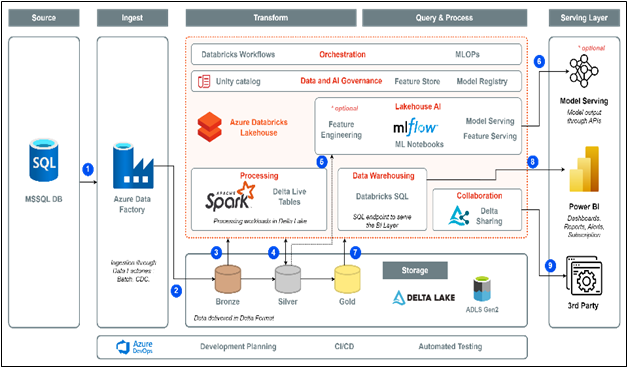
The architecture integrates batch and near real-time ingestion using Change Data Capture (CDC), stores data in Delta tables on ADLS Gen2, and enables seamless consumption through BI tools and APIs.
Outcomes
- 40% reduction in annual infrastructure costs
- 3X faster data refresh cycles, completing within an hour
- Near real-time sales reporting enabled
- Month-on-month reporting for strategic planning
- Column-level masking and row-level access control implemented via Unity Catalog
Technologies Used
- Databricks
- Azure Data Lake Storage Gen2
- Delta Live Tables
- Unity Catalog
- MLflow
- Power BI
- Azure Data Factory
The transformation empowered the NBFC with a scalable, governed, and real-time data platform. It enabled faster decision-making, improved operational efficiency, and laid the foundation for advanced analytics and AI-driven insights.


.svg)

.svg)
.svg)
.svg)