


In today’s fast-paced financial services environment, data is more than just numbers—it’s the foundation for strategic decisions, customer insights, and operational efficiency. One of India’s prominent non-banking financial companies (NBFCs), with a strong focus on home finance, faced mounting challenges in managing its growing data volumes and delivering timely insights to business stakeholders.
The Challenge: Fragmented Data, Delayed Decisions
The organization struggled with:
- Lack of real-time data pipelines, leading to delayed insights
- Inconsistent KPI logic across departments, resulting in misaligned decisions
- Frequent null values in reports due to inefficient data refresh methods
- High infrastructure costs from legacy systems
- Absence of data lineage and cataloging, which slowed down analytics and onboarding
These issues not only hampered decision-making but also eroded trust in the data and increased operational overhead.
The Solution: Unified Data Platform on Databricks
To address these challenges, the company partnered with Exponentia.ai to implement a modern, scalable data architecture. The solution included:
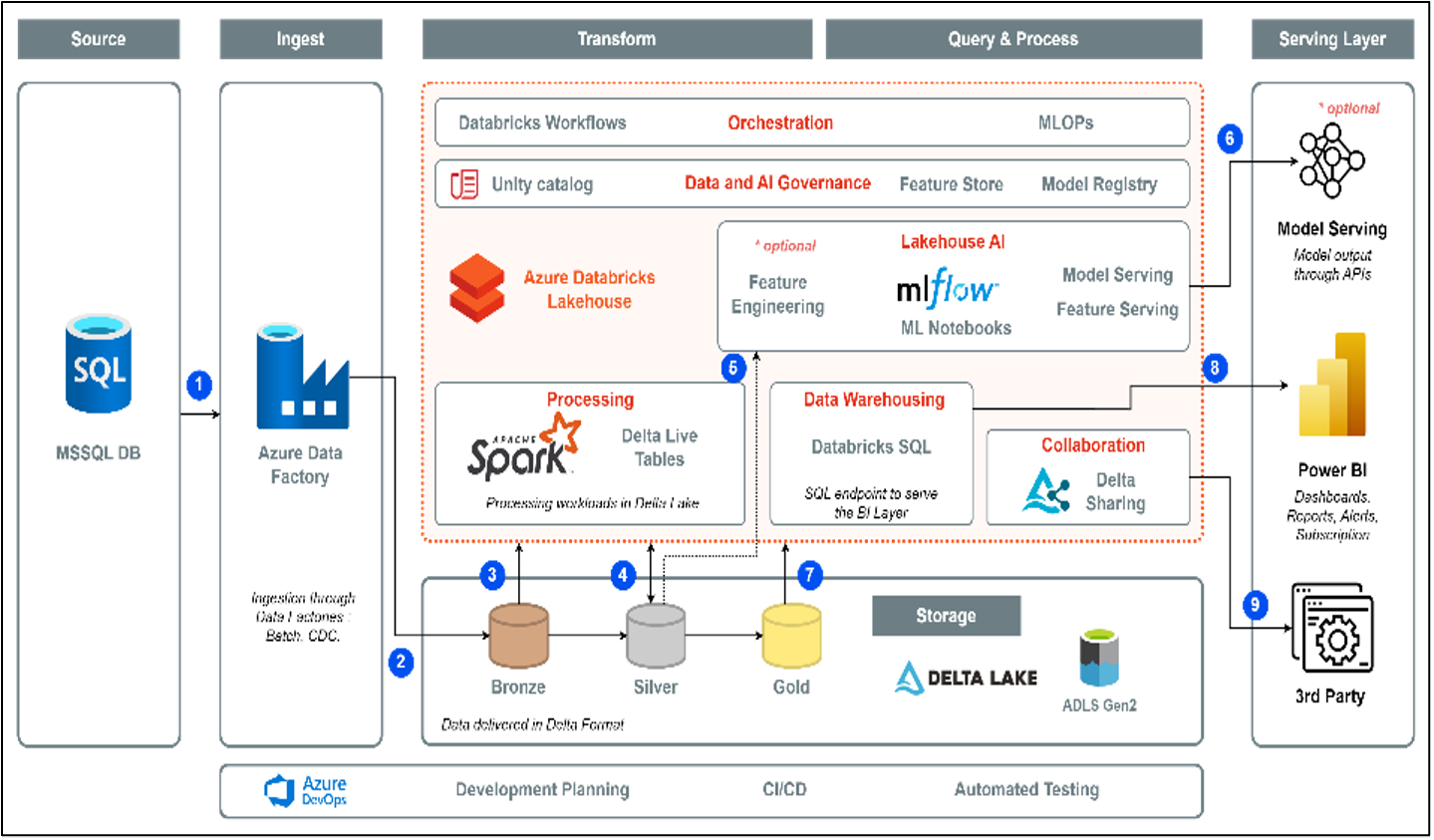
- Databricks-based Unified Data Platform (UDP) using the Medallion architecture (Bronze, Silver, Gold layers)
- Delta Live Tables (DLT) for real-time and incremental data loading
- Unity Catalog for centralized data governance, lineage tracking, and business glossary
- MLflow for machine learning model development and deployment
- Power BI dashboards connected via Databricks SQL endpoints for real-time reporting
This architecture enabled seamless ingestion from MSSQL via Azure Data Factory, transformation using Apache Spark, and consumption through BI tools and APIs.
The solution architecture featured:
- Batch and near real-time ingestion using Change Data Capture (CDC)
- Delta tables stored in ADLS Gen2
- ML models integrated with MLflow for predictive analytics
- Role-based and attribute-based access controls via Unity Catalog
The Impact: Speed, Savings, and Scalability
The transformation delivered measurable business outcomes:
- 40% reduction in annual infrastructure costs
- 3X faster data refresh cycles, completing within an hour
- Near real-time sales reporting, improving responsiveness
- Month-on-month reporting for strategic planning
- Advanced data governance with column-level masking and row-level access control
Conclusion
By embracing a unified data platform and modern cloud-native tools, the NBFC not only resolved its data challenges but also laid the foundation for scalable analytics, AI-driven insights, and robust governance. This transformation is a testament to how financial institutions can unlock the full potential of their data to drive growth, efficiency, and customer-centric innovation.
.jpg)







%20(1).jpg)

.jpg)



.svg)

.svg)
.svg)
.svg)