
Over the past several months, I’ve had the opportunity to speak with leaders across manufacturing, media, life sciences and financial services about how AI is evolving inside their businesses.
Some of these conversations have been through Applied AI Outcomes. Others have happened at industry forums, including our recent BFSI Leadership Forum with Databricks, where I moderated a discussion with financial-services leaders around a deliberately practical theme: AI That Moves the Needle
What interests me most is not what AI can do. We already know its capabilities are advancing extraordinarily quickly.
The more important question is: what changes when AI becomes part of how an enterprise actually operates?
Across industries, I see four perspectives shaping that conversation

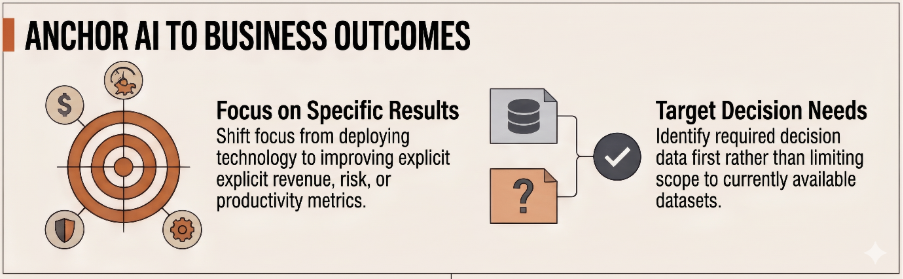
1. Start with the outcome, not the technology
Perhaps the strongest theme I hear is the need to anchor AI to an outcome.
In life sciences, my conversation with Arvind Balasundaram explored the importance of looking beyond the data already available and thinking about the information required to address a specific business objective.
The same thinking surfaced in financial services. At our Databricks forum, I asked participants to come with one strategic outcome they wanted to impact over the next 12 months, whether revenue, retention, operational efficiency, risk or employee productivity.
That changes the conversation from“Where can we deploy AI?” to“Which business outcome or decision are we trying to improve?”
AI should follow the outcome, not the other way around.
2. Autonomy needs context
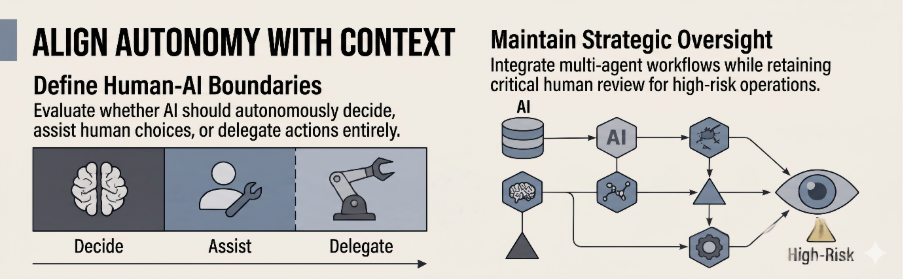
Agentic AI is understandably attracting enormous interest. But the industry conversations I’m hearing suggest that the goal cannot simply be greater autonomy.
In manufacturing, my discussion with Ashish Srivastava of Daikin Applied Americas brought out the realities of introducing AI into operational environments. Questions of reliability and predictability are accompanied by a very human question: is AI here to replace people or help them?
Financial services introduces another dimension. In preparing for our panel discussion, we explored how multiple agents could operate across processes while retaining human oversight for critical decisions. We also questioned what an AI-native financial institution designed today might do differently from one built a decade ago.
This leads me to a more useful question than whether something can be autonomous:
Should AI make this decision, assist with it, or leave it with a human?
An AI-native enterprise needs to be deliberate about where AI acts, where people decide, and where they work together.
3. Trust becomes a continuous discipline
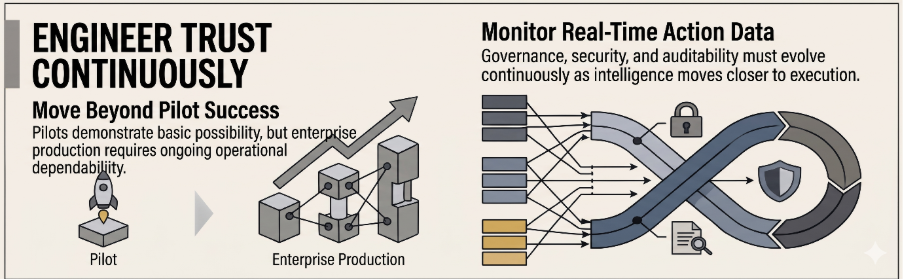
The difference between experimentation and production also comes through repeatedly.
A pilot demonstrates possibility. Production demands dependability.
In manufacturing, the discussion went beyond the quality of source data to the importance of monitoring data created when AI itself is in action, together with continuous training and monitoring of AI outcomes.
In financial services, the questions become even more consequential. As organizational data is increasingly consumed by copilots, AI agents and autonomous workflows, governance has to evolve with it. Auditability, risk, security and human oversight become more important as intelligence moves closer to action. This was a core part of the discussion Ram designed for the Databricks BFSI panel.
Trust cannot be a checkpoint before deployment. It has to be continuously engineered into how AI operates.
4. AI maturity is about operating differently
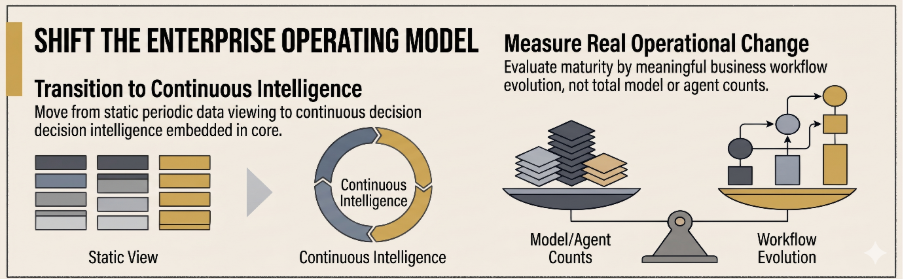
Perhaps the biggest perspective I take from these conversations is that becoming AI-native is ultimately an operating-model shift.
In media, Bhaskar Borah, SVP Marketing at Dow Jones, sees the questions evolving beyond AI itself to how organizations make data AI-ready, unlock enterprise knowledge, improve discovery, and strengthen decision intelligence.
In life sciences, Arvind Balasundaram used an analogy that stayed with me: enterprises have traditionally looked at “stills,” while advances in AI increasingly allow us to watch the “movie.” Intelligence can become more continuous, contextual and closer to the point of decision.
And after our financial-services panel, one observation stood out to me: the breadth of AI use cases across insurance and financial services indicates that AI is becoming increasingly industrialized and integrated into core business functions
That is an important distinction
AI maturity should not be measured by the number of pilots, models or agents an enterprise has. It should be measured by how meaningfully intelligence changes the way the enterprise operates.
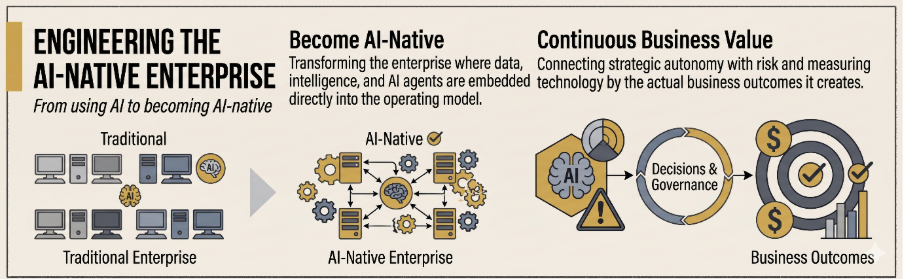
From using AI to becoming AI-native
Taken together, these conversations are shaping my own understanding of the AI-native enterprise.
It is not simply an enterprise with more AI.
It is an enterprise where data, intelligence and increasingly AI agents become part of the operating model. Where intelligence moves closer to decisions. Where autonomy reflects context and risk. Where governance evolves as AI evolves. And where technology is ultimately measured by the business outcomes it helps create.
That is what Engineering the AI-Native Enterprise means to me.
Not simply becoming an enterprise that uses AI.
Becoming an enterprise that operates differently because of it.
What this means from Exponentia.ai’s perspective
At Exponentia.ai, we see a few capabilities becoming increasingly important as enterprises move towards an AI-native operating model:
- Establish an AI CoE for scale: Create the enterprise mechanism to build, govern, operate and drive adoption of AI consistently across the organization.
- Build Vertical AI around business outcomes: Move from generic AI capabilities to persona-based outcome centers designed around specific functions, roles, decisions and measurable outcomes.
- Reimagine workflows around humans + AI agents: Don’t simply add AI to existing processes. Redesign workflows around where people decide, where agents act and where they work together.
- Engineer for production and adoption: Build governance, monitoring, operations and adoption into the AI lifecycle so successful use cases can move beyond pilots and scale reliably across the enterprise.
For us, Engineering the AI-Native Enterprise is ultimately about bringing these elements together to make AI repeatable, governed and outcome-led at enterprise scale.
Continue the conversation
The AI-native enterprise is still being defined. And some of its most valuable perspectives are coming from leaders putting AI to work inside their businesses today.
Through Applied AI Outcomes, I’m continuing these conversations with industry leaders about what’s working, what’s changing, and what we are discovering as AI moves deeper into the enterprise.
If you’re leading this change in your industry, I’d value your perspective. Join me for an Applied AI Outcomes conversation and help shape the dialogue on what comes next.